
EOCC Release Paths
Harrison County says some people granted judicial release may have to complete an EOCC program. Judicial release is a Common Pleas action that modifies a prison term and can impose community control, conditions, and residential programming. The phrase does not mean that all correctional control has ended.
Read the journal entry for its effective date, community-control term, conditions, and EOCC requirement. ODRC may retain a Judicial Release or supervision status. The supervising office can confirm the current phase. The Harrison County release search path distinguishes this placement from county discharge.
| Record phrase | Safe meaning | Source |
|---|---|---|
| Judicial release | Court modified a prison term | Common Pleas entry |
| EOCC placement | Residential program condition | Court order |
| Community control | Court supervision continues | Journal and supervisor |
| Program completion | One condition may be complete | Program and court record |
Confirm EOCC Release Records
Start with the Harrison Common Pleas docket and locate the signed judicial-release entry. Match the person and sentence, then read the effective date and each residential or supervision condition. Check ODRC by name or offender number for the same Harrison commitment and any Judicial Release or supervision status.
Contact the supervising office or EOCC through the route named in the order when the current phase is unclear. No verified EOCC address, phone, or hours appear in the reviewed official sources. A later violation or revocation entry can return the person to custody, so read later docket entries as well.
- Find the signed judicial-release entry.
- Read the date and EOCC condition.
- Match the person in ODRC.
- Confirm residential status with the named office.
- Check for later completion or revocation.
Important: A missing row is not proof of release. Eastern Ohio Correction Center records must distinguish community release from continued custody.
EOCC Records Contact
No verified EOCC street address, phone, or public hours appear in the reviewed official sources. Do not infer them. The Harrison Common Pleas Clerk can provide the journal entry, and ODRC Central Records is the documented state-record route.
Harrison Clerk of Courts100 West Market Street
Cadiz, OH 43907
Phone: 740-942-8863
Monday through Friday, 8:00 a.m. to 4:00 p.m.
Supply the person's full name, offender number if known, Harrison County docket, and the exact fields sought. Useful fields include admission, institution history, sentence, expected date, parole or release detail, and public supervision information. The Harrison Common Pleas Clerk remains the source for the judgment and later judicial entries.
Note: No published Eastern Ohio Correction Center fee, turnaround, or historical online release archive was found, so confirm terms before requesting copies.
EOCC Court Record Boundaries
A Harrison jail roster cannot show whether a person has completed EOCC residence or remains on community control. The Common Pleas journal and supervising office are the primary sources. ODRC can add state status and release detail when the placement followed a prison term.
| Source | Question answered |
|---|---|
| Common Pleas journal | What judicial release ordered |
| EOCC or supervisor | Whether residential participation continues |
| ODRC detail | State sentence, release, or supervision status |
| Later docket entries | Completion, modification, violation, or revocation |
Read the sequence, not one label. Judicial release can coexist with residential programming. Program completion may lead to another supervised phase. A violation may return the matter to court. Each change needs its own date and source.
When two sources appear inconsistent, record the date each was updated and ask the office that owns the disputed field. The clerk owns journal entries, ODRC owns its public state fields, and the program or supervising office owns current participation facts. Keeping those roles separate prevents a stale online label from replacing a verified event.
EOCC Residential Placement Meaning
EOCC placement is a structured residential step. It may follow departure from prison, but the person can remain bound by court and community-control rules. Do not describe arrival at EOCC as release home.
Program completion also needs context. Read whether supervision continues after residence ends. A later violation can produce a hearing or revocation. The court owns those changes, while the program or supervisor owns current participation facts.
- Transfer
- Movement to another custodian while confinement continues.
- Community release
- Departure from custody rather than a move to another jail or prison.
- Disposition
- The recorded reason and destination attached to the exit event.
EOCC Judicial Release Evidence
Judicial release comes from a court order, not an automatic date calculation. The entry should establish the sentence change and each community-control or residential term. Keep it with any ODRC release detail because each source proves a different part of the transition.
If ODRC shows Judicial Release, APA Supervision, or Released, interpret it with the court order. APA is state supervision. Community control is court supervision. EOCC residence is a program condition. These phases can overlap or follow one another.
EOCC Offender Search Fields
ODRC accepts Last Name, First Name, County of Commitment, Residential County, ZIP, Status, next hearing month, and offender number. Search broad first, then narrow. Residential County and ZIP apply to certain supervision or violator records and do not identify the sentencing county.
The detail may show status, photo, admission, institution, offenses, sentence, jail credit, expected date or eligibility date, reviews, release detail, APA office, and conditions. Offense data may be incomplete, so verify the Harrison judgment.
The ODRC offender-search page displays the public identity, county, status, hearing, and number fields.
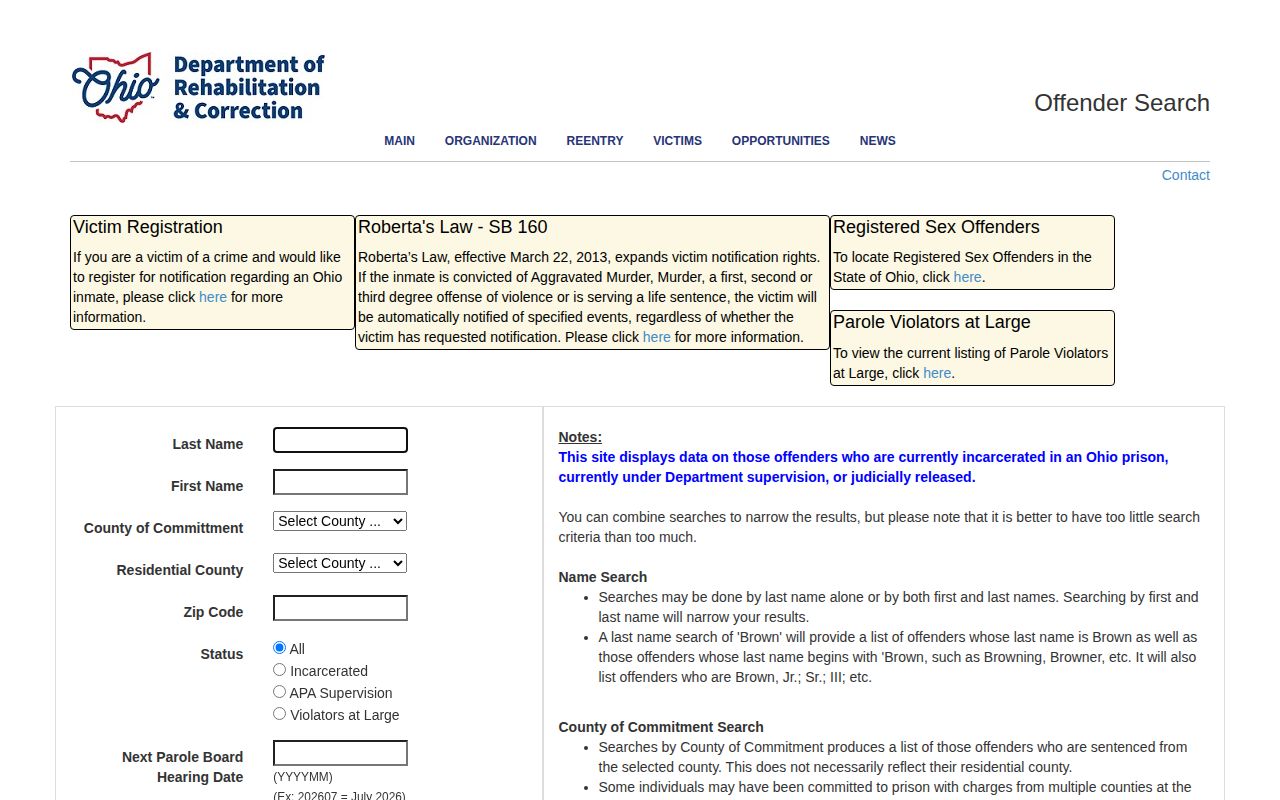
The search form shows why a Harrison commitment should be narrowed with both identity and custody fields.
Note: ODRC can lag, and its expected date is not proof that release has occurred.
Get EOCC Release Proof
The strongest local result combines two sources. Ask Eastern Ohio Correction Center for the custody event, including the actual date, time, disposition, and destination. Then obtain the matching court entry that authorized bond, dismissal, sentence completion, commitment, judicial release, or another outcome. The sources may post at different times. Keep the report date and identifiers so a later update can be reconciled.
If the event was a transfer, continue with the receiving agency instead of closing the search. If it was an ODRC commitment, use the state offender number when available. If it was a true community release, check the docket for any pending case dates or supervision terms. Precise wording matters: say released from Eastern Ohio Correction Center only when the record shows custody ended, and name the next custodian when it did not.
A focused request should identify the Harrison case number, the judicial-release entry, the residential placement dates, and the exact completion or exit event sought. Ask the clerk for later modifications and revocation entries, not just the order that began placement. If ODRC data are part of the chain, include the offender number and ask Central Records for the specific public release or supervision fields. This combined record shows whether EOCC residence ended, whether supervision continued, and whether a later court action changed the outcome.
Begin with the Harrison County Clerk of Courts, since Common Pleas journal entries supply the authority for judicial release and later changes. The county's Community Corrections office is the local supervision route when the order places the person on community control. Ask which office owns the current phase rather than assuming that program completion ended supervision. The residential provider, supervising office, ODRC, and court can each hold a different part of the same transition.
Use the ODRC Offender Search when the EOCC placement followed a state sentence. Match the offender number, Harrison commitment, and docket. A Judicial Release or APA field must be read with the court order because those statuses describe different kinds of oversight. If the online systems disagree, preserve their displayed dates and ask the office that owns the disputed field. That evidence distinguishes release from prison, entry into residential programming, later completion, continued supervision, and any return to custody.
A release record for this path should name each stage separately. Record the prison departure, EOCC admission or residential start, program completion or exit, continuing community-control term, and any later modification or revocation. Do not compress those events into one date. If no EOCC-specific public record is online, request the court entry and ask the named supervising office for the current public status. A precise chronology shows which restraint ended and which one remained.