
Harrison Projected Versus Actual Release
A projected date is a calculated future point based on the sentence and information then available. ODRC labels its field “Expected Release Date/Parole Eligibility Date.” The agency defines it as a projected release date or a date pending parole consideration. POA means parole on or after. PRD means projected release date. Those terms must remain distinct because an eligibility date may lead to a review rather than release.
An actual release is a completed custody event. For a state prisoner, ODRC status, Parole or Release Detail, and supervision fields become more useful after the event. For a Harrison County Jail case, the jail's release record should state the actual date, time, disposition, and destination. The court order supplies the authority. A person may leave one building through transfer while remaining in custody.
A pretrial detainee has no sentence-based end date. Bond may authorize release, but another warrant or hold may prevent departure. A dismissal also needs to be read with the custody record. The actual outcome can only be established by joining the jail event to the court action.
Find a Harrison Projected Date
First identify whether the person has a local jail sentence, an unresolved case, or an Ohio prison sentence. Harrison sends male prison commitments to the Correctional Reception Center and female commitments to the Ohio Reformatory for Women for intake. Those moves end the county-jail stay but begin state custody. ODRC can follow the person after later transfer to a parent institution.
- Read the Harrison court docket. County Court handles misdemeanor and traffic cases, while Common Pleas handles felonies and prison commitments.
- For an Ohio prison sentence, open the ODRC Offender Search. Search by last name, then narrow by first name, offender number, or County of Commitment.
- Match the person by offender number, Harrison docket, admission, offenses, and sentence. Do not rely on name alone.
- Read “Expected Release Date/Parole Eligibility Date” with the displayed PRD or POA label. Check the next hearing or review if present.
- For a Harrison jail sentence, request the sentencing entry, jail commitment, jail-time credit, consecutive or concurrent structure, and the jail's current calculation.
- After the date arrives, confirm actual release, transfer, or continued custody with the keeper of the record.
The ODRC search form includes status, County of Commitment, Residential County, ZIP, next parole-hearing month, and offender number. Residential County is limited to certain supervision searches. It does not replace the committing-county field or prove where a person now lives.
An offender number is the strongest public search key when available. ODRC requires six digits without spaces or hyphens. Its records use A and R prefixes for men and W for women, with a leading zero added when a woman's number otherwise has five digits. Search results should still be checked against the Harrison committing county and docket because a person can have cases from more than one county.
The official Ohio search form shows the filters used for Harrison prison commitments.
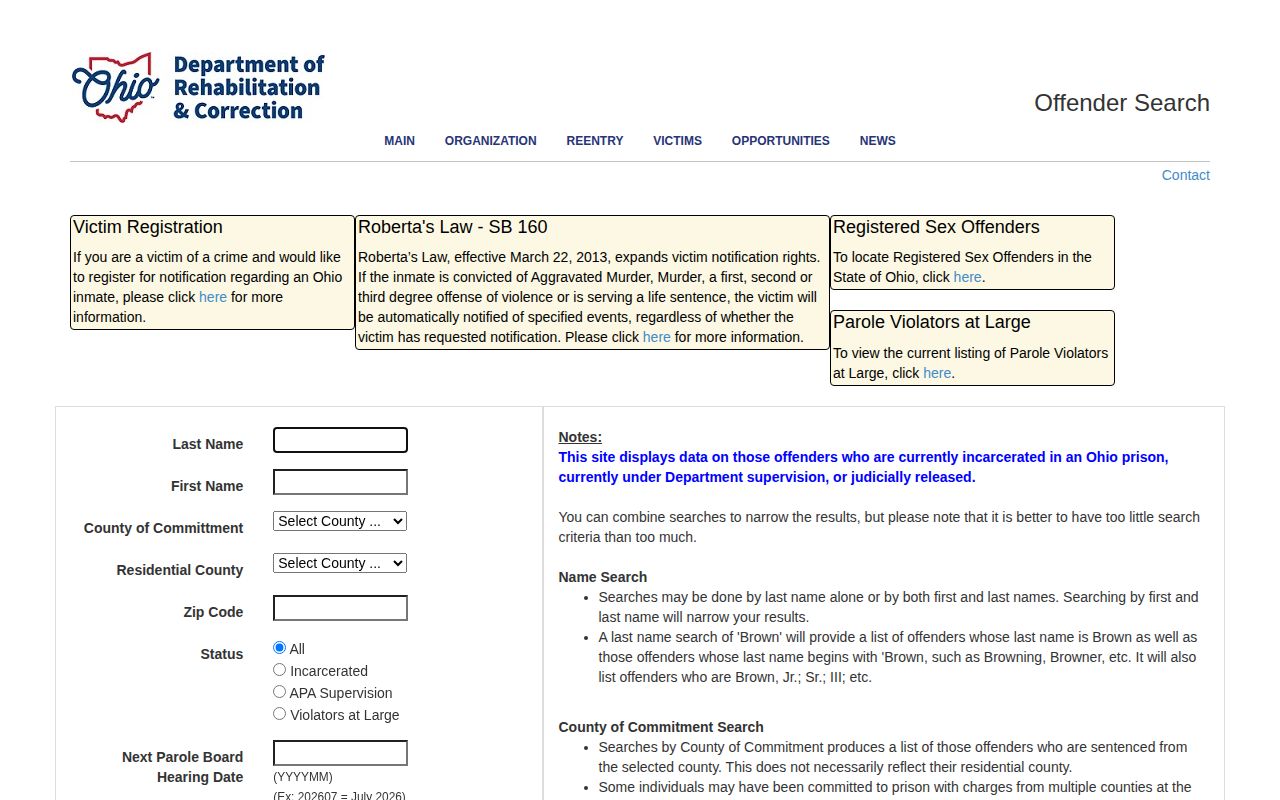
The Released and APA Supervision filters help separate a past prison departure from ongoing state supervision.
The broader Harrison County released inmate lookup explains how to confirm a completed county or state custody event.
Harrison ODRC Release-Date Fields
The ODRC detail record carries more than one time-related field. Admission Date begins the displayed state custody period. Sentence Effective Date and jail-time credit help explain computation. Expected Release Date/Parole Eligibility Date states the current projection or eligibility point. Parole or Release Detail is populated after parole or release and can preserve the later event. Supervision Start Date and Period of Supervision address the next legal stage.
| ODRC field | What it answers | Key limit |
|---|---|---|
| Expected Release Date/Parole Eligibility Date | Current projected date or pending-parole point | Not an actual discharge timestamp |
| PRD | Projected release date | Can change before release |
| POA | Parole on or after the date | Does not promise release that day |
| Parole or Release Detail | Later parole or release information | Read with status and sentence |
| APA Supervision | Person is outside prison under state supervision | Not full discharge from the sentence |
The ODRC definitions page gives the agency's exact meanings.
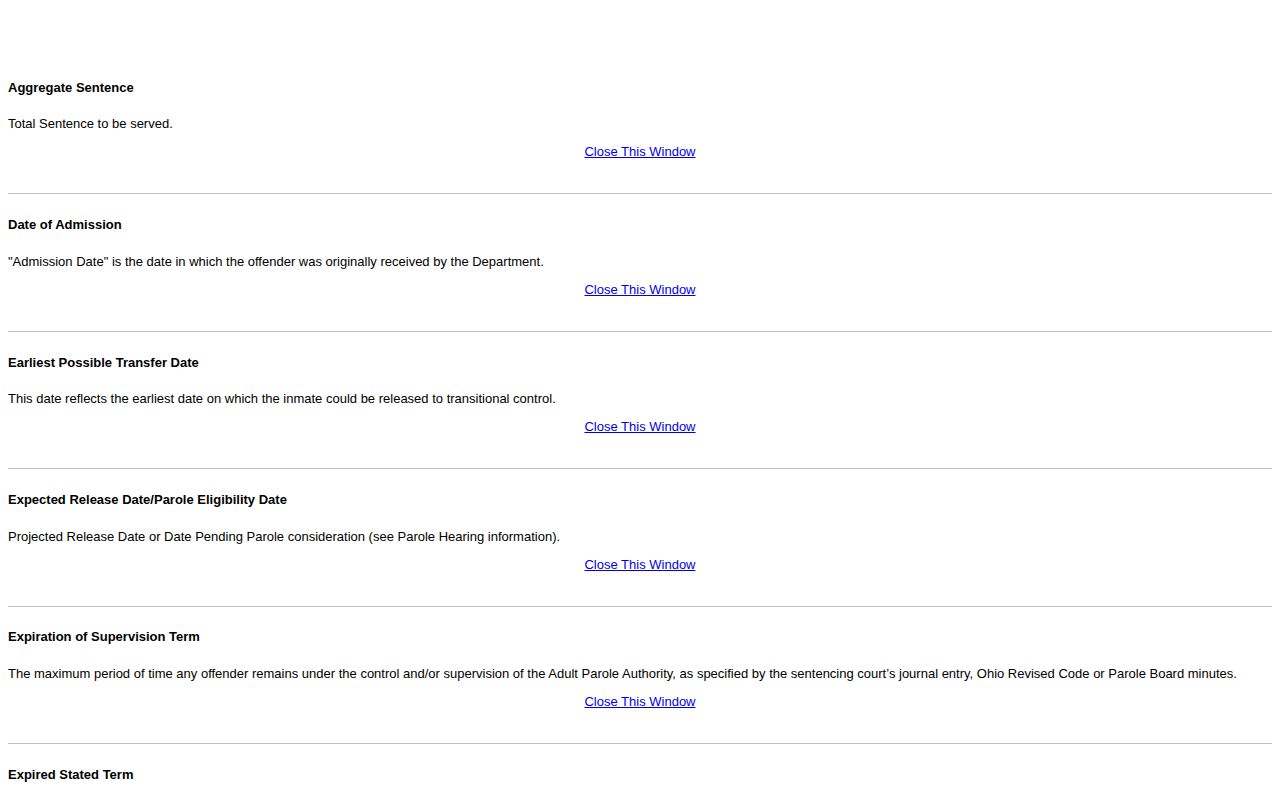
The definitions prevent a projected date, parole point, and release detail from being collapsed into one event.
Note: ODRC covers Ohio prison and APA records, not a county-only bond release or Harrison Jail discharge.
Ohio Credits Affecting Harrison Releases
Ohio's current earned-credit law is ORC 2967.194 for qualifying time confined from April 4, 2024. Eligible prisoners may provisionally earn one or five days for each completed month of productive programs or activities, based on the statutory category. A second completed qualifying program or activity can support up to five added days. Rule violations can cause credits to be denied or withdrawn.
The statute also provides a qualifying completion credit of 90 days or ten percent of the stated prison term, whichever is less. Many offense and sentence exclusions apply. The ordinary combined participation and completion credits addressed in division (A)(2) are capped at fifteen percent of the stated term. That cap creates the rough arithmetic of serving about 85 percent for some eligible terms, but Ohio has no universal rule that everyone serves 85 percent.
Mandatory or nonreducible terms, murder and aggravated murder, life without parole, specified sex or violent offenses, older sentences, judicial release, parole decisions, discipline, and other rules can reduce or eliminate credit. ORC 2967.193 applies to relevant earlier confinement. The rules cannot be read from the offense headline alone.
Credits are provisional until the agency applies them to the eligible term. Program participation does not by itself guarantee every available day, and completion credit has its own statutory tests. The sentence effective date, stated term, excluded portions, and later conduct all matter. That is why the ODRC displayed date, rather than a private estimate, should be recorded when tracking a Harrison prison case.
The official earned-credit statute page is the source for the current categories and caps.
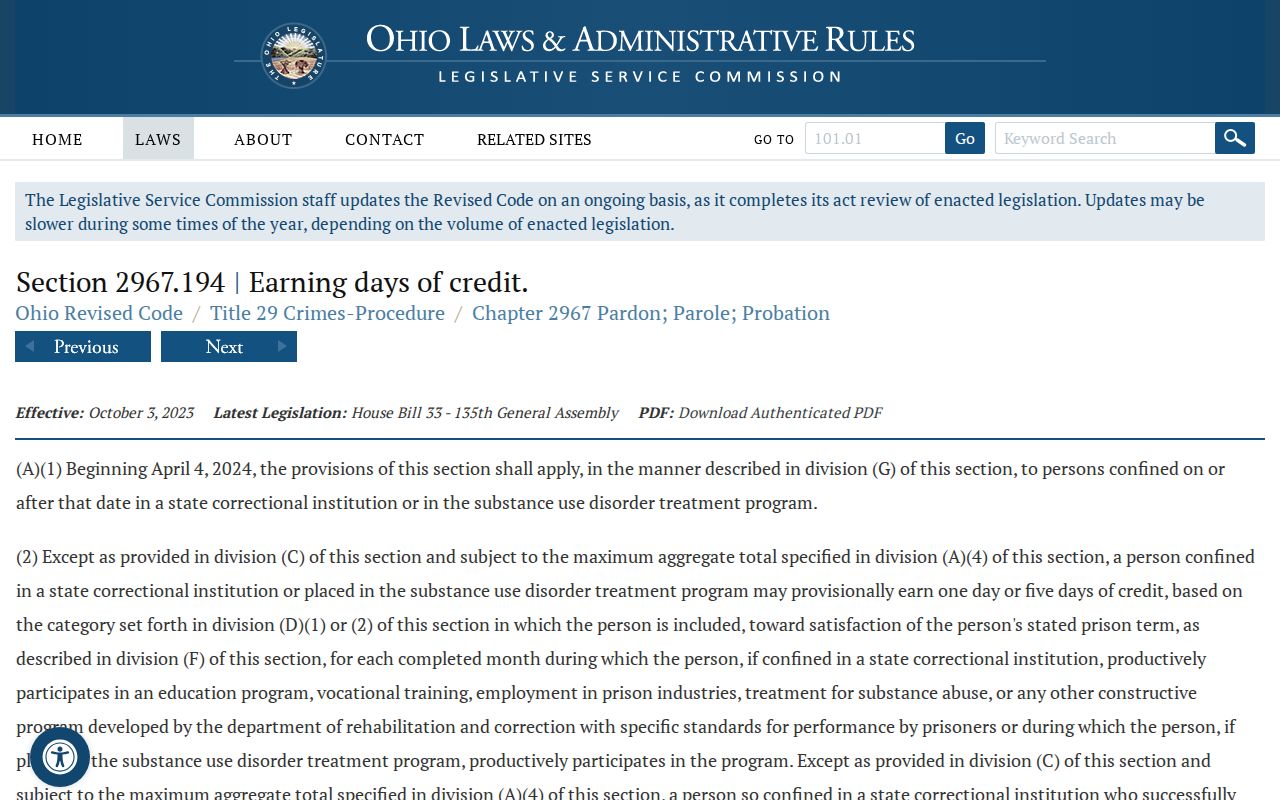
The statute's exclusions and credit structure show why simple sentence subtraction can yield the wrong date.
Harrison Sentence Computation Rules
Other Ohio provisions shape the projected date. ORC 2967.191 addresses jail-time credit. That credit accounts for qualifying confinement before prison and must be tied to the sentence calculation. ORC 2967.271 governs presumptive release and possible rebuttal for qualifying indefinite first- and second-degree felony terms under the Reagan Tokes framework.
Ohio Administrative Code 5120-2-03.2 supplies administrative sentence-computation rules across sentencing eras. ORC 2967.13 governs parole eligibility for relevant sentences. An eligibility point means the person may be considered. It is not a promised release date.
Consecutive terms are served one after another. Concurrent terms run at the same time to the extent ordered. A detainer is another agency's request or legal basis to hold or receive the person. Judicial release is a court order under state law, not an automatic credit calculation. Each item can alter what the expected date means.
- Jail-time credit
- Qualifying time already confined that is credited to the sentence.
- Earned credit
- A statutory reduction available only under defined conditions and limits.
- Parole eligibility
- The date consideration may begin, not the date release must occur.
- Detainer
- A hold or request from another authority that may block community release.
Harrison Jail Out Date Limits
Harrison's weekly Current Inmates PDF has an “Out Date” column, but the county does not define that field as the actual release date. Observed rows can contain a future date, and a row can remain on the current list with a value. Out Date may reflect a planned sentence end, a scheduled point, or another jail-management entry. Preserve the label exactly and ask the jail what it means for the named person.
A Harrison county-jail date is not calculated with the ODRC earned-credit formula. Start with the sentencing entry, commitment, jail-time credit, concurrent or consecutive structure, and any valid local order or credit. No official Harrison jail good-time formula, weekend-release rule, holiday adjustment, or release procedure was found in the reviewed sources. The jail and sentencing court are the correct sources.
The weekly PDF's Housing field also matters. Harrison uses Jefferson and Carroll County jails as contract housing destinations. A person can leave Cadiz, retain the same Harrison holding authority, and continue the local sentence elsewhere. Ask Harrison Jail whether it remains the committing agency, whether another jail now houses the person, and which agency will execute the final discharge.
A second warrant, another county's hold, state commitment, federal process, or transfer to Jefferson or Carroll County can prevent community release. Ask whether all holds cleared, whether the date is planned or completed, and where custody went next.
If Common Pleas grants judicial release, read the journal entry for its effective date and conditions. Harrison reports that some judicial-release orders can require residential programming at Eastern Ohio Correction Center. In that setting, the legal label “judicial release” does not mean the person went straight home. The court order, ODRC status, and program contact must be read together.
Why Harrison Release Dates Change
A projected date reflects a calculation at one point in time. Later credit, discipline, court action, parole review, or another custody claim may alter it. The type of case decides which source can explain the change.
| Factor | Possible effect | Confirm with |
|---|---|---|
| Earned credit added or withdrawn | Moves a qualifying prison projection | ODRC sentence record and statute |
| Jail-time credit correction | Changes credited days | Court entry and ODRC or jail calculation |
| Discipline or indefinite-term rebuttal | May delay expected prison release | ODRC public fields and governing order |
| Parole review | Eligibility may lead to later action or denial | Parole Board result and ODRC detail |
| Judicial release | Court can change the custody path | Common Pleas journal entry |
| Detainer or transfer | Ends one custody layer without community release | Releasing and receiving agencies |
When a date is close, register for a custody notice, then confirm the event with the custodian. The Harrison County VINELink check explains the alert process. VINE is a signal, not the final release record.
Note: A date disappearing from a web record can reflect a recalculation or data update rather than a completed discharge.